A refreshing approach for mutual success.
Value engineering is our core philosophy — and it starts with your business context, not our code.
Engineering value that speaks to your budget
Most technology programmes are bought on a business case and delivered on a task list. The case is written once — for the steering committee — and then nobody owns it. Budgets go live; outcomes don't. We keep the business case on the table from the first workshop to the final acceptance — so that your IT budget really looks like a business investment.
Discover, enable & realize business value — with deliverables you approve before you pay.
Transformation usually disconnects between multiple vendors.
The Board/CEO/Owners buy strategy from a top consultancy. The CFO/COO buys policy and processes from big firms. The CIO/IT Management buys systems from system integrators. Three contracts, three deliverables — and no one really owns the space between them.
That gap is where transformations stall. Final Quotient sits across all three, connecting the dots between strategy, people, process and technology — so the pieces add up to the outcome you funded.
Why implementations succeed with us
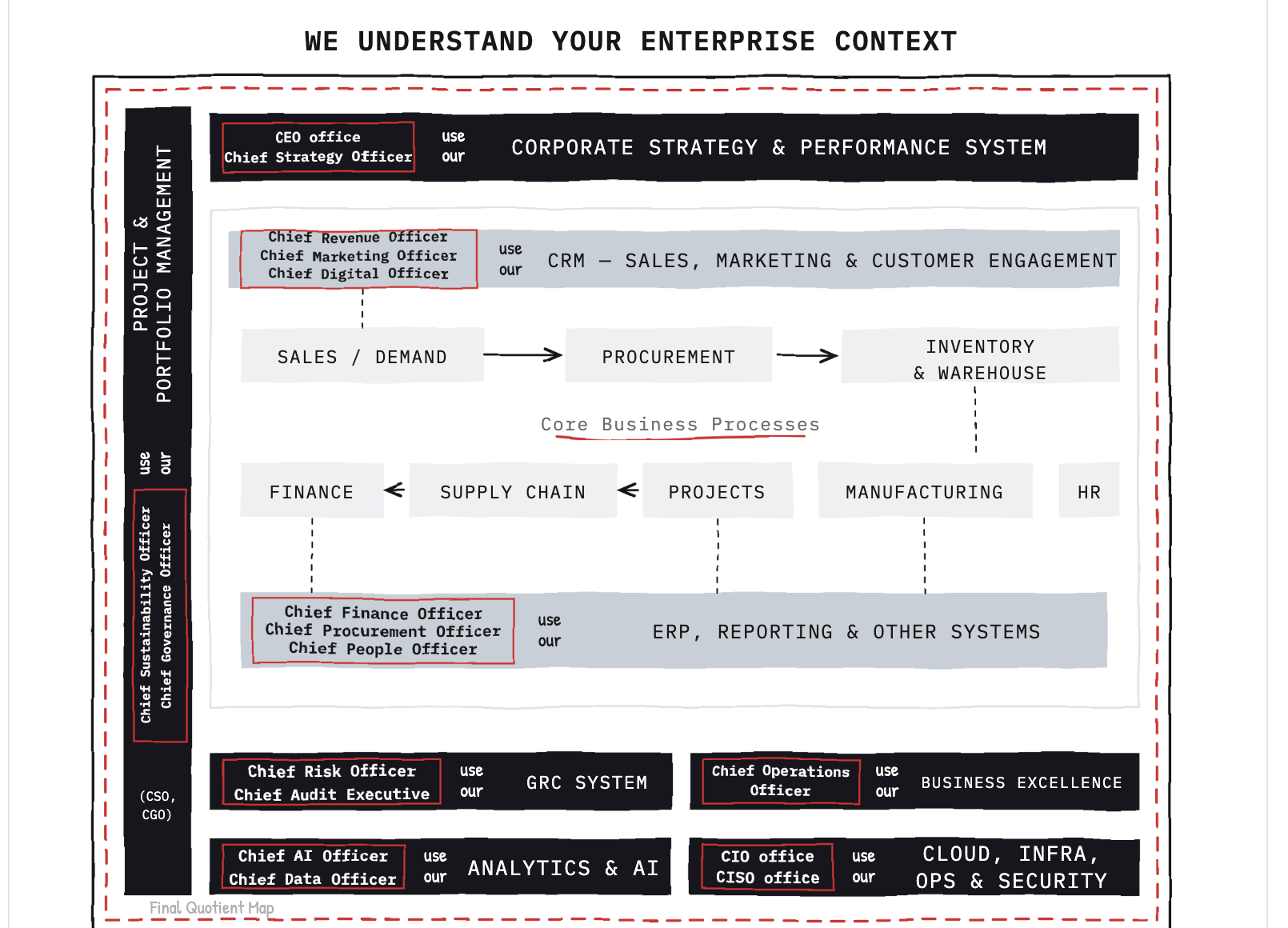
Before we touch a single system, we map how your business actually runs — every function, every hand-off, every dependency between them. Most implementations fail not because the software is wrong, but because nobody understood the context it had to live in — the way strategy flows into finance, how procurement feeds ERP, where risk and compliance cut across everything. Understanding the interconnections, not just the modules, is exactly why we are best placed to make an implementation actually succeed.
The map below is how we hold that whole picture in view.
Book a scoping call
Bring us a business outcome. We will show you the path to it.